

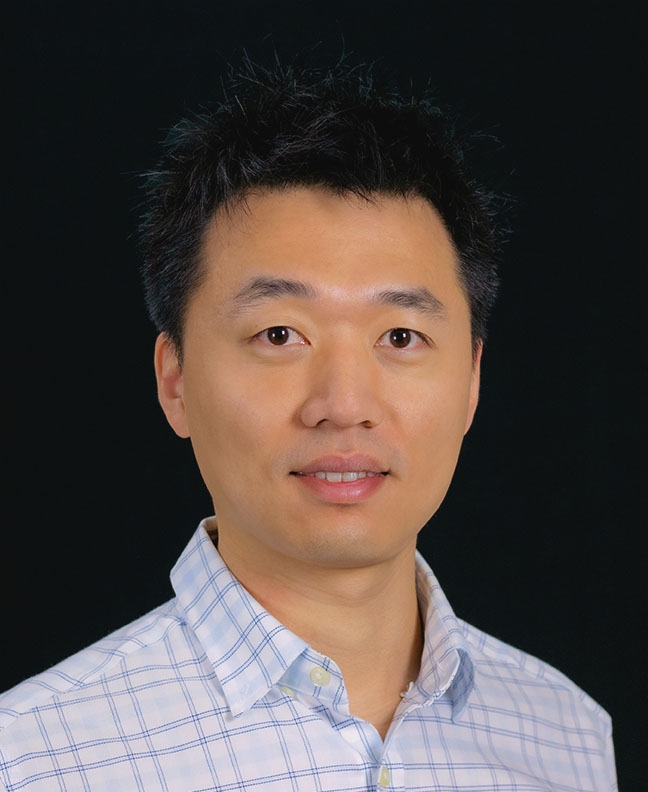
JILA Associate Fellow Shuo Sun.
JILA is proud to introduce our newest Associate Fellow—Shuo Sun.
Sun’s research focuses on light-matter interactions at the quantum limit, where single photons and single atoms can strongly interact. These interactions will expand our knowledge of quantum interactions, but Sun is particularly interested in how quantum light-matter interactions can be used for quantum information technologies.
There are many possible platforms scientists are exploring to build quantum computers, a quantum internet, and new quantum sensors, such as trapped ions or superconducting qubits. Optical photons are the only qubits that can travel long distances with small losses, which makes them indispensable for quantum communication channels in quantum networks and distributed quantum computers, Sun explained.
“We are interested in exploring more quantum information processing capabilities with photons, including optical quantum computing and quantum simulation, by employing the quantum nonlinear effect created by strong atom-photon interactions,” he added.
The Sun Lab is also pursuing several research projects to convert quantum information to optical photons, or using photons to mediate remote entanglement. Sun and his group are studying how to generate, control, and manipulate solid-state artificial atoms, which are made of semiconductor nanocrystals or atomic defects and impurities, and use them to store and process quantum information. One interesting feature about these artificial atoms is that they can be conveniently coupled with optical photons through engineered nanophotonic structures defined in their host materials, explained by Sun.
Sun joins JILA after a postdoc and research scientist position at Stanford University. He received his master’s and Ph.D. in electrical engineering from University of Maryland, College Park, and his bachelor’s in optics from Zhejiang University.
He’s become fond of driving and road trips since driving from Maryland to Stanford. When he’s not in the lab, he also enjoys hiking, skiing, and premier league soccer.
 The Physics Frontiers Centers (PFC) program supports university-based centers and institutes where the collective efforts of a larger group of individuals can enable transformational advances in the most promising research areas. The program is designed to foster major breakthroughs at the intellectual frontiers of physics by providing needed resources such as combinations of talents, skills, disciplines, and/or specialized infrastructure, not usually available to individual investigators or small groups, in an environment in which the collective efforts of the larger group can be shown to be seminal to promoting significant progress in the science and the education of students. PFCs also include creative, substantive activities aimed at enhancing education, broadening participation of traditionally underrepresented groups, and outreach to the scientific community and general public.