

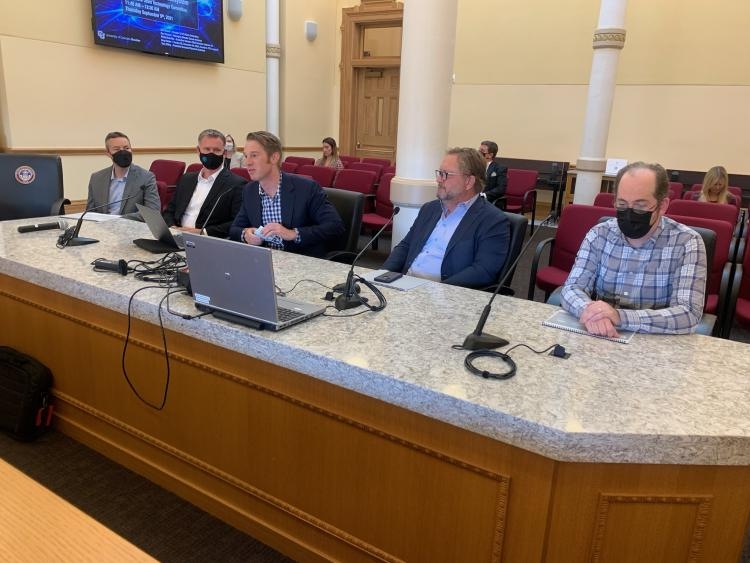
Philip Makotyn, center, presenting before the Colorado General Assembly's Joint Technology Committee on Sept. 9, 2021.
Earlier this month, quantum technology made a splash at the Colorado Capitol. Philip Makotyn, executive director of the CUbit Quantum Initiative, spoke on Sept. 9 before the Colorado General Assembly's Joint Technology Committee.
Makotyn was one of several people who spoke before the committee on the Colorado Front Range quantum ecosystem, including CU's role in quantum research; describing the Colorado quantum ecosystem including quantum sensing and computing; what quantum computing is (and isn't) and its applications across a variety of industries and problems.
Joining Makotyn in speaking before the committee were Ben Bloom, founder and chief technical officer at Atom Computing; Dan Caruso, managing director at Caruso Ventures; Greg Rieker, CUbit associate director, Vogel Family Faculty Fellow and associate professor of mechanical engineering at CU Boulder; and Tony Uttley, president at Honeywell Quantum Solutions.
Focusing on an interdisciplinary approach to research and education in quantum information science and technology, the CUbit Quantum Initiative coordinates quantum activities at CU Boulder, catalyzing focus areas and research centers across the university.
You can listen to the presentation here.
Written by CU Boulder Today.
 The Physics Frontiers Centers (PFC) program supports university-based centers and institutes where the collective efforts of a larger group of individuals can enable transformational advances in the most promising research areas. The program is designed to foster major breakthroughs at the intellectual frontiers of physics by providing needed resources such as combinations of talents, skills, disciplines, and/or specialized infrastructure, not usually available to individual investigators or small groups, in an environment in which the collective efforts of the larger group can be shown to be seminal to promoting significant progress in the science and the education of students. PFCs also include creative, substantive activities aimed at enhancing education, broadening participation of traditionally underrepresented groups, and outreach to the scientific community and general public.