

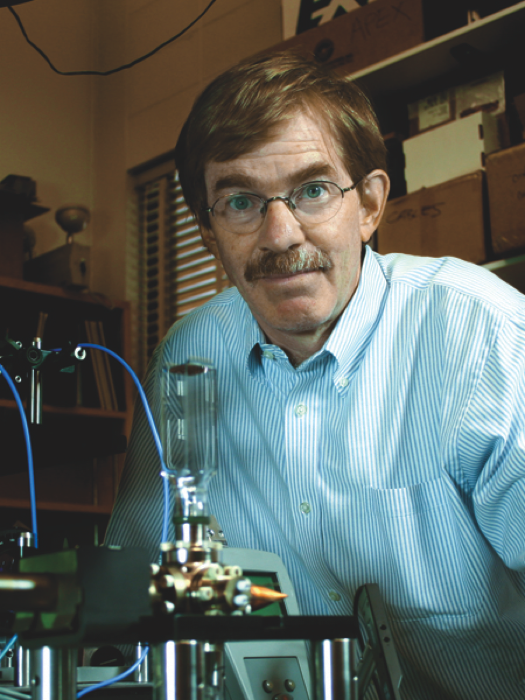
Fellow Dana Anderson has won a CO-LABS 2014 Governor’s Award for High-Impact Research in Foundational Technology. Anderson’s work in the commercialization of cold-atom technology also received an Honorable Mention for the development of a strong public/private partnership.
Anderson will be recognized on November 12 when CO-LABS and the Alliance for Sustainable Energy host a night at the Denver Museum of Nature and Science to honor the achievements of Colorado’s federally funded research centers.
In bestowing the award, CO-LABS highlighted Anderson’s work on the practical applications of cold-atom technology. Applications include the development of cold-atom inertial sensors and the creation of a cold-atom research module to be placed on the International Space Station in 2016. In the future, Anderson’s cutting-edge research in cold-atom technology may lead to revolutionary advances in navigation and guidance, gas exploration, advanced communication technologies, and quantum computing.
Anderson co-founded the company ColdQuanta, which was recently named Boulder Company of the Year by the University of Colorado’s Technology Transfer Office.
CO-LABS is a nonprofit organization that works to inform the public about the breakthroughs and impacts from Colorado’s 30 federally funded labs and research facilities. The CO-LABS consortium includes Colorado federal research laboratories, research universities, state and local governments, economic development organizations, private businesses and nonprofit organizations.
 The Physics Frontiers Centers (PFC) program supports university-based centers and institutes where the collective efforts of a larger group of individuals can enable transformational advances in the most promising research areas. The program is designed to foster major breakthroughs at the intellectual frontiers of physics by providing needed resources such as combinations of talents, skills, disciplines, and/or specialized infrastructure, not usually available to individual investigators or small groups, in an environment in which the collective efforts of the larger group can be shown to be seminal to promoting significant progress in the science and the education of students. PFCs also include creative, substantive activities aimed at enhancing education, broadening participation of traditionally underrepresented groups, and outreach to the scientific community and general public.