

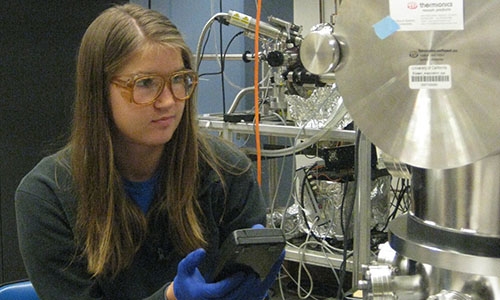
Phoebe Tengdin ‘13 likes things cold … very cold.
That’s because she conducts experiments in a field known as atomic physics and quantum optics, developing systems to study the properties of atoms when they become extremely cold. If all goes according to plan, experimental apparatus that Tengdin is designing and building will be used miles above the Earth on the International Space Station.
Principal Investigators
Research Areas
 The Physics Frontiers Centers (PFC) program supports university-based centers and institutes where the collective efforts of a larger group of individuals can enable transformational advances in the most promising research areas. The program is designed to foster major breakthroughs at the intellectual frontiers of physics by providing needed resources such as combinations of talents, skills, disciplines, and/or specialized infrastructure, not usually available to individual investigators or small groups, in an environment in which the collective efforts of the larger group can be shown to be seminal to promoting significant progress in the science and the education of students. PFCs also include creative, substantive activities aimed at enhancing education, broadening participation of traditionally underrepresented groups, and outreach to the scientific community and general public.