


JILA Fellow W. Carl Lineberger has been awarded the 2015 Dudley Herschbach Prize for Experiment, which includes a Dynamics of Molecular Collisions Medal. Lineberger is E. U. Condon Distinguished Professor of Chemistry at the University of Colorado, Boulder. The 2015 Dudley Herschbach Prize for Theory and a Dynamics of Molecular Collisions Medal were given to Millard Alexander, University of Maryland Distinguished University Professor of Chemistry and Biochemistry.
The pair of awards has been presented every two years since 2007 for “bold and architectural work, inspiring and empowering. Such work addresses fundamental, challenging, frontier questions; brings forth new perspectives and capabilities; and typically excites evangelical fervor that recruits many followers,” Herschbach states on the Dynamics of Molecular Collisions Medals website.
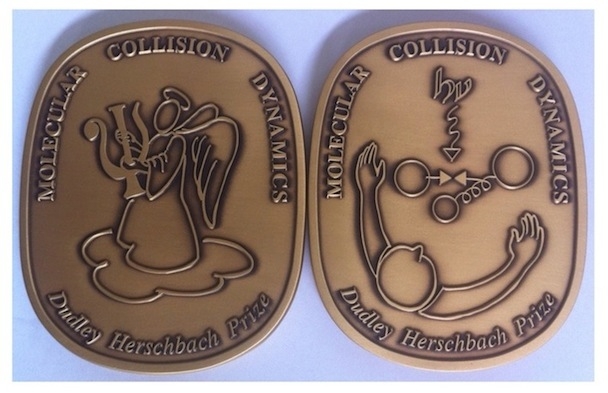
Dynamics of Molecular Collisions Medals for Theory (l) and Experiment (r).
Lineberger currently serves as a Member of the National Science Board and its Executive Committee, the National Research Council Laboratory Assessments Board, and the Advisory Editorial Board of Chemical Physics Letters. He is a member of the National Academy of Sciences and the American Academy of Arts and Sciences; he is a Fellow of the American Physical Society and the American Association for the Advancement of Science as well as a member of the American Chemical Society. Lineberger has won many awards during his illustrious career, including the Herbert P. Broida Prize in Atomic and Molecular Spectroscopy or Chemical Physics from the American Physical Society, the William F. Meggers Prize from the Optical Society of America, and the American Chemical Society’s Irving Langmuir Prize in Chemical Physics and Peter Debye Award in Physical Chemistry.
 The Physics Frontiers Centers (PFC) program supports university-based centers and institutes where the collective efforts of a larger group of individuals can enable transformational advances in the most promising research areas. The program is designed to foster major breakthroughs at the intellectual frontiers of physics by providing needed resources such as combinations of talents, skills, disciplines, and/or specialized infrastructure, not usually available to individual investigators or small groups, in an environment in which the collective efforts of the larger group can be shown to be seminal to promoting significant progress in the science and the education of students. PFCs also include creative, substantive activities aimed at enhancing education, broadening participation of traditionally underrepresented groups, and outreach to the scientific community and general public.