

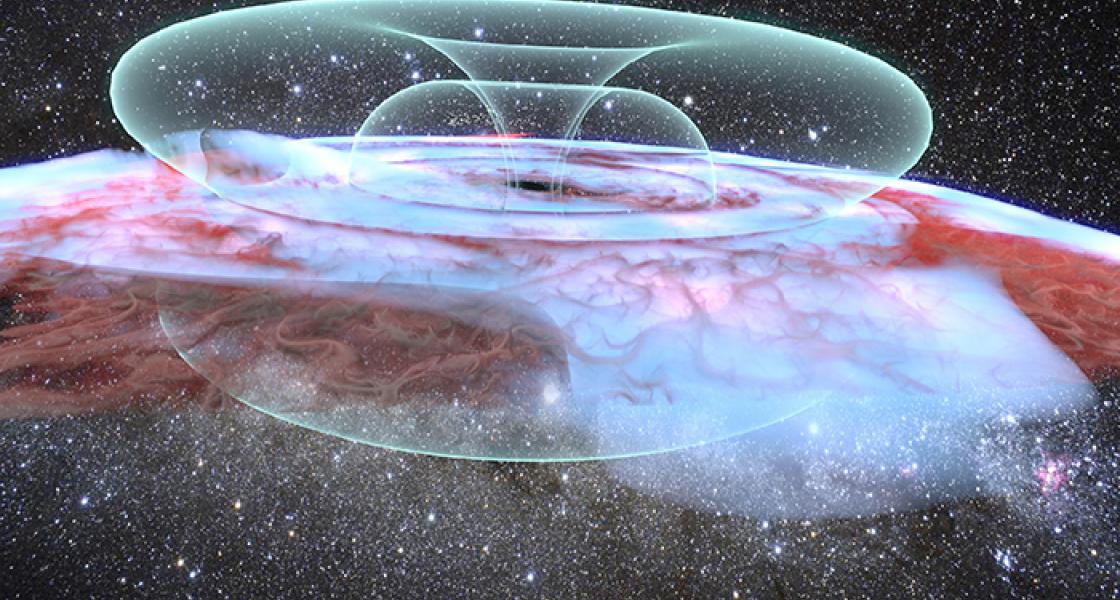
Fellow Mitch Begelman and colleague Marek Sikora of the Polish Academy of Sciences have proposed a solution for the long-standing puzzle of what causes black holes to launch powerful jets. Jets are extremely energetic material (plasma) traveling at very close to the speed of light and spanning distances of thousands to hundreds of thousands of light years. The dominant factor in the creation of jets is the presence of a strong, directional magnetic field (known as magnetic flux) threading the black hole (as shown in the figure). And, because magnetic flux threading a black hole is relatively rare, the new paradigm also explains why less than 10% of the “active” supermassive black holes at the center of galaxies emit jets.
Active black holes voraciously feed on relatively thin clouds of cold gas. These writhing, twisting gas clouds typically create fairly strong magnetic fields. But, the cold gas is far too turbulent to carry much of the magnetic field close to the black hole. It’s unusual for the black holes feeding on cold gas clouds to start spitting out vast amounts of matter and energy in the form of jets.
The trigger for jet emergence is the buildup of magnetic flux in a sequence of events involving a merger between elliptical galaxy and a spiral galaxy. Elliptical galaxies contain large masses of hot gas that drag magnetic fields into the vicinity of the black hole — but not inside it. Then, when an elliptical galaxy merges with a spiral galaxy, the cold gas in the spiral galaxy pushes the magnetic field the rest of the way into the black hole.
This two-step process threads the magnetic field through the black hole. At the same time, it causes the magnetic field to become organized with well-defined north and south poles. The black hole is now like a gargantuan bar magnet with a mass of millions to billions of suns. It emits powerful jets traveling close to the speed of light in opposite directions. The amount of power propelling these jets is a function of the strength of the magnetic flux running through it.
Begelman and Sikora say that this mechanism explains the origin of jets from quasars. Observations have shown that quasars with jets are surrounded by thin, cold disks of swirling gas. The researchers argue that these quasars must have previously encountered hot gas from an ancient elliptical galaxy before an encounter with a spiral galaxy created the cold disk.
This work is an excellent example of the fruitful international collaborations JILA is known for throughout the world. Sikora has come to JILA seven times since 1995, including once as Visiting Fellow. He was Begelman’s postdoc from 1985 to 1990. — Julie Phillips
 The Physics Frontiers Centers (PFC) program supports university-based centers and institutes where the collective efforts of a larger group of individuals can enable transformational advances in the most promising research areas. The program is designed to foster major breakthroughs at the intellectual frontiers of physics by providing needed resources such as combinations of talents, skills, disciplines, and/or specialized infrastructure, not usually available to individual investigators or small groups, in an environment in which the collective efforts of the larger group can be shown to be seminal to promoting significant progress in the science and the education of students. PFCs also include creative, substantive activities aimed at enhancing education, broadening participation of traditionally underrepresented groups, and outreach to the scientific community and general public.