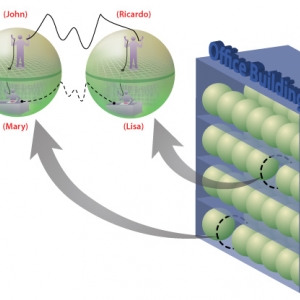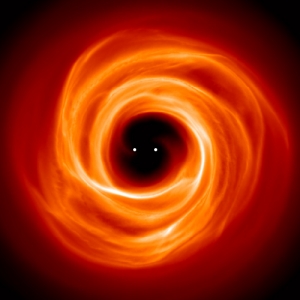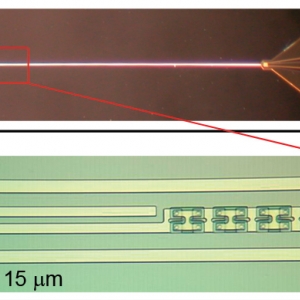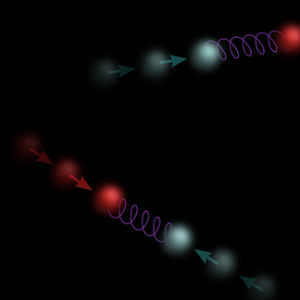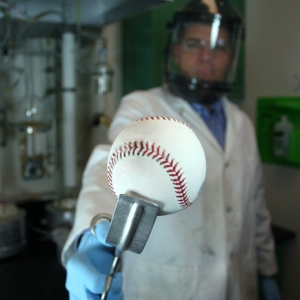
Fellows Ana Maria Rey and Jun Ye have come up with a clever idea that should make it much easier to design a quantum computer based on alkaline-earth atoms such as strontium (Sr). In this work, they collaborated with former research associate Marty Boyd, former JILA Fellow Peter Zoller (University of Innsbruck), and colleagues from Harvard University and the University of Innsbruck.
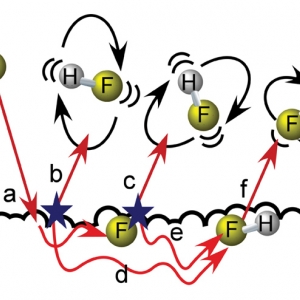
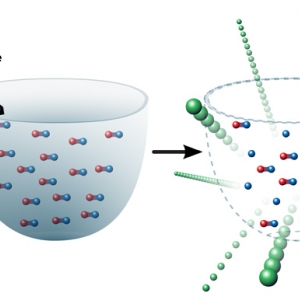
Imagine being able to study how molecules form on the quantum level. It turns out that researchers have already figured out some nifty techniques involving lasers and jets of reactive atoms for doing just that in a gaseous environment. Now graduate student Alex Zolot, former Visiting Fellow Paul Dagdikian of Johns Hopkins University, and Fellow David Nesbitt have taken this kind of study into a whole different arena: They recently probed the molecules that form when the surface of a liquid is bombarded with a very reactive gas.
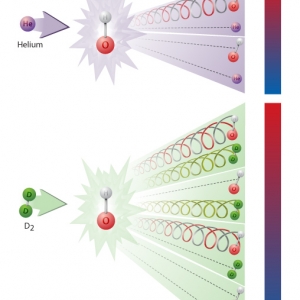
Last year the Ye group conducted an actual laboratory astrophysics experiment. Graduate students Brian Sawyer, Ben Stuhl, and Mark Yeo, research associate Dajun Wang, and Fellow Jun Ye fired cold hydroxyl (OH) radicals into a linear decelerator equipped with an array of highly charged electrodes and slowed the OH molecules to a standstill. These molecules were then loaded into a permanent magnetic trap where they became the stationary target for collision studies. Next, Sawyer and his colleagues aimed supersonic beams of either helium (He) atoms or deuterium molecules (D2) at the OH molecules. They then studied the resulting low-energy collisions, which took place at temperatures of 80–300 K.
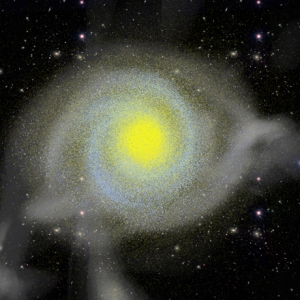
The "dark ages" of the early Universe drew to a close with the appearance of enough stars to strip electrons off most of the hydrogen atoms in the gas clouds between galaxies. By a billion years after the Big Bang, these reionized atoms had rendered the Universe transparent to light. About 12.7 billion years later, visiting JILA member Gayler Harford, Fellow Andrew Hamilton, and Nickolay Gnedin of the Kavli Institute for Cosmological Physics decided to investigate the structures formed by ordinary matter (baryons) and dark matter soon after the reionization process was complete.
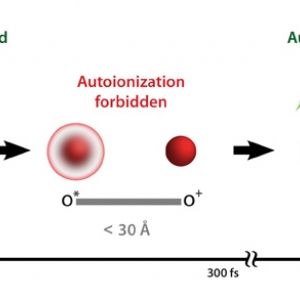
An oxygen molecule (O2) doesn't fall apart so easily — even when an X-ray knocks out one of its electrons and superexcites the molecule during a process called photoionization. In this process, the X-ray first removes an electron from deep inside the molecule, leaving a hole in O2+. Then, an outer electron can fall into the hole, and a second outer electron gets ejected, carrying away any excess energy. The loss of the second electron is known as autoionization, or Auger decay.
In a rural northern Colorado landscape punctuated by plentiful corn fields, a tree farm, an abandoned feedlot, and a handful of McMansions, only one thing is certain: the exact time. The nation’s backup time scale, consisting of four atomic clocks, two measurement systems, and supporting hardware is tucked away inside radio station WWV's remote transmission station, located 12 miles northwest of Fort Collins. Fellow Judah Levine travels to the station site an average of once a week to check on the performance of the backup time scale, which he designed and built in 2005.
Researchers in the Kapteyn/Murnane group have decided to use soft X-ray bursts to watch the interplay of electronic and atomic motions inside a molecule. Such information determines how chemical bonds are formed or broken during chemical reactions.
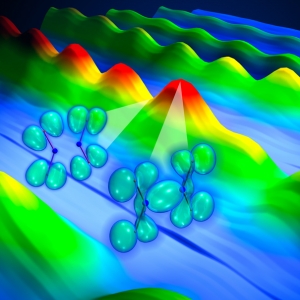
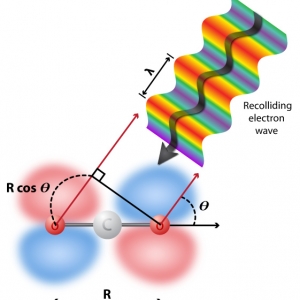
Xibin Zhou and his colleagues in the Kapteyn/Murnane group have come up with a clever new way to study the structure of carbon dioxide (CO2) and other molecules. The researchers use two innovative tools: (1) coherent electrons knocked out of the CO2 molecules by a laser and (2) the X-rays produced by these electrons when they re-collide with the same molecules. The coherent electrons and X-rays are produced in a process known as high harmonic generation.
The mission to find the electron electric dipole moment (eEDM) recently took a menacing turn. Chief Eric Cornell and his protégés were already hard at work characterizing the hafnium fluoride ion (HfF+). Their goal was to be the first in the world to complete the mission. In their choice of molecule, they owed a lot to JILA theorists Ed Meyer and John Bohn (a.k.a. Agents 13 and 86), who had taken the theory world by storm in 2006 when they devised a simple and straightforward method for the evaluation of molecular candidates for an eEDM search.
Until recently, astronomers have had difficulty figuring out the composition and size of dust grains in galaxies beyond the Milky Way. They've had some luck with the Large and Small Magellanic Clouds (LMC and SMC, respectively). However, these two "satellite" galaxies are practically our next-door neighbors and much easier to observe.
Astrophysicists know that the centers of galaxies have supermassive black holes whose size correlates with the size of the galaxy surrounding them. They’ve also observed that galaxies collide and merge. In fact, galactic mergers were even more common billions of years ago in the Universe when today’s galaxies were still being assembled.
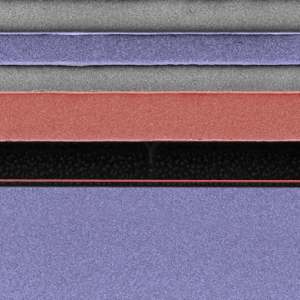
Fellow Konrad Lehnert needed a virtually noiseless amplifier to help with his experiments on nanoscale structures, so he invented one. Working with graduate student Manuel Castellanos-Beltran and NIST scientists Kent Irwin, Gene Hilton, and Leila Vale, he conceived a tunable device that operates in frequencies ranging from 4 to 8 GHz. This device has the lowest system noise ever measured for an amplifier. In fact, it produces 80 times less noise than the best commercial amplifier. More importantly, it adds no noise to a measurement system — a critical feature for a system probing the quantum limits of measurement.
The Jin and Ye groups recently crafted an entirely new form of matter — tens of thousands of ultracold polar molecules in their lowest energy state. The ground-state molecules are too cold to exist naturally anywhere in the Universe. But, like the Bose-Einstein condensates discovered in the mid-1990s, they promise to open the door to unprecedented explorations of the quantum world, including quantum information processing and exquisite precision measurement. That these molecules exist at all is a testament to the clever ideas and persistence of the Jin and Ye groups.
The John Bohn lab at JILA owes its very existence to a 2002 decision by the Colorado Rockies to begin storing baseballs in a room with ~50% humidity. The conventional wisdom at the time was that Denver’s thinner air was responsible for making Coors Field a hitter’s heaven. In mile-high Denver, hitters averaged two more home runs per game because the thinner air caused a given home run ball to travel 20 feet further than at sea level.
The Jin group recently came up with the first strong experimental link between superfluidity in ultracold Fermi gases and superconductivity in metals. What’s more, this feat was accomplished with photoemission spectroscopy, a tried-and-true technique that has been used for more than 100 years to study solids. This technique has been instrumental in revealing the properties of superconductors. It is just beginning to be developed in ultracold Fermi gases, where it could prove to be just as useful.
Like people, planets can migrate far from where they were born. In the case of planets, they usually travel toward their parent star, but some may also move away. Some wind up in blistering proximity to their Sun-like parents, orbiting them in 1.2 to 8 days. Such orbits are well inside the magnetic-field-induced cavities that typically separate such stars from their planet-forming accretion disks. There’s no way planets could have formed in these cavities, given their lack of raw materials for planet building and incredibly high temperatures.
Nanoartisans Cindy Regal, John Teufel, and Konrad Lehnert have come up with a clever new way to observe ordinary (very small) things behaving quantum mechanically. They’ve tucked a nanomechanical beam (which is actually a really thin aluminum wire) inside a tiny resonant microwave cavity made of lightweight superconducting aluminum. This design ensures that very small forces will cause large detectable motion.
What happens to a Bose-Einstein condensate (BEC) when its atoms interact strongly? One possibility for large attractive interactions is that the condensate shrinks and then explodes, as the Cornell and Wieman groups discovered in 2001.
Fellow Jun Ye’s group is methodically working its way toward the creation of an X-Ray frequency comb. Recently, senior research associate Thomas Schibli, graduate student Dylan Yost, Fellow Jun Ye, and colleagues from IMRA America, Inc. developed a high-performance, ultrastable fiber laser optical frequency comb. At the same time, Yost developed a clever method for getting coherent short-wavelength light out of a femtosecond enhancement cavity used with the fiber laser. These achievements have opened the door to the generation of frequency combs in the extreme ultraviolet (EUV) and soft X-ray regions of the electromagnetic spectrum.
Graduate student Robyn Levine, Fellow Andrew Hamilton, and colleagues from the University of Chicago’s Kavli Institute for Cosmological Physics are working on modeling how supermassive black holes grow inside galaxies.