

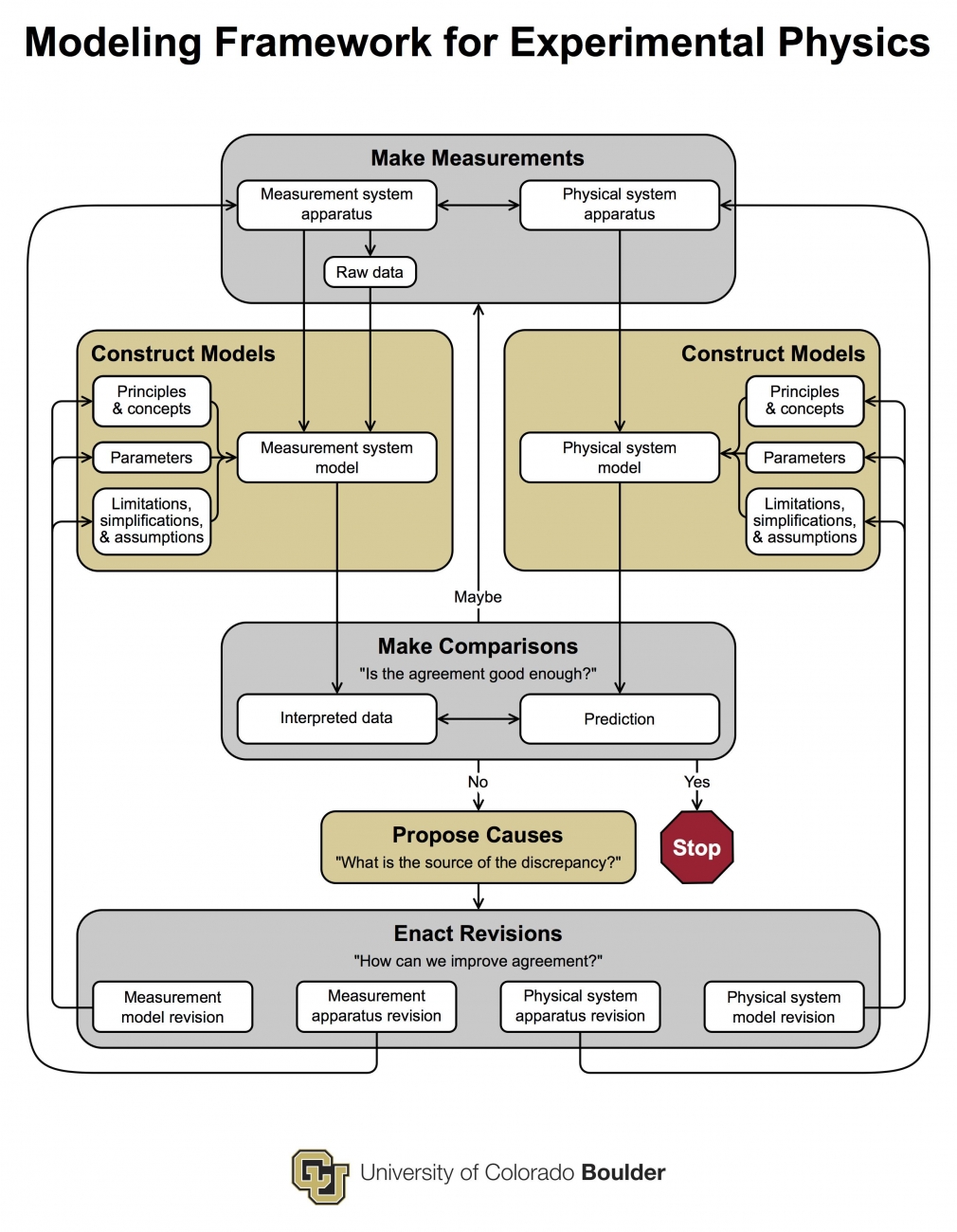
Models are abstract representations of the real world. A well-defined model is associated with a target system or phenomenon of interest, and can be used for either explanatory and/or predictive purposes. Modeling is the iterative process through which models and systems are brought into better agreement, either by refining the model or the target system itself. As a practice integral to experimental physics, modeling often appears as a learning goal for undergraduate physics laboratory courses at both the national and local levels.
We have investigate students' use of modeling in lab courses in a variety of ways. We developed the Experimental Modeling Framework (EMF) to characterize students' model-based reasoning and to inform the development of instructional lab environments that engage students in the process of modeling. We have applied this framework in the context of upper-level lab courses. We have also developed an assessment (MAPLE) to evaluate students' model-based reasoning.
 The Physics Frontiers Centers (PFC) program supports university-based centers and institutes where the collective efforts of a larger group of individuals can enable transformational advances in the most promising research areas. The program is designed to foster major breakthroughs at the intellectual frontiers of physics by providing needed resources such as combinations of talents, skills, disciplines, and/or specialized infrastructure, not usually available to individual investigators or small groups, in an environment in which the collective efforts of the larger group can be shown to be seminal to promoting significant progress in the science and the education of students. PFCs also include creative, substantive activities aimed at enhancing education, broadening participation of traditionally underrepresented groups, and outreach to the scientific community and general public.