

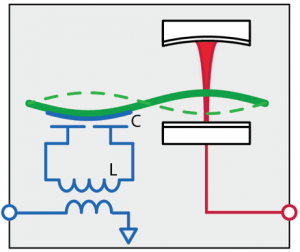
Electro-optic devices are ubiquitous in classical optical systems. In the quantum domain, an electro-optic device would also be very handy, for example, to transduce states created with superconducting quantum bits (qubits) to optical light. However, at the moment no electro-optic component exists that is low enough noise and efficient enough to work with quantum states. In collaboration with Konrad Lehnert's group (JILA) we believe the control of phonon modes that has been developed in optomechanics and electromechanics could provide the requisite quantum link between microwave and optical photons. In our work a metallized silicon nitride membrane is simultaneously coupled to an electrical resonator and an optical cavity. This system creates a device that we have demonstrated is uniquely bidirectional and efficient. Our current work studies the potential for the transduction of quantum states with low added noise at cryogenic temperatures required for superconducting qubits.
 The Physics Frontiers Centers (PFC) program supports university-based centers and institutes where the collective efforts of a larger group of individuals can enable transformational advances in the most promising research areas. The program is designed to foster major breakthroughs at the intellectual frontiers of physics by providing needed resources such as combinations of talents, skills, disciplines, and/or specialized infrastructure, not usually available to individual investigators or small groups, in an environment in which the collective efforts of the larger group can be shown to be seminal to promoting significant progress in the science and the education of students. PFCs also include creative, substantive activities aimed at enhancing education, broadening participation of traditionally underrepresented groups, and outreach to the scientific community and general public.