

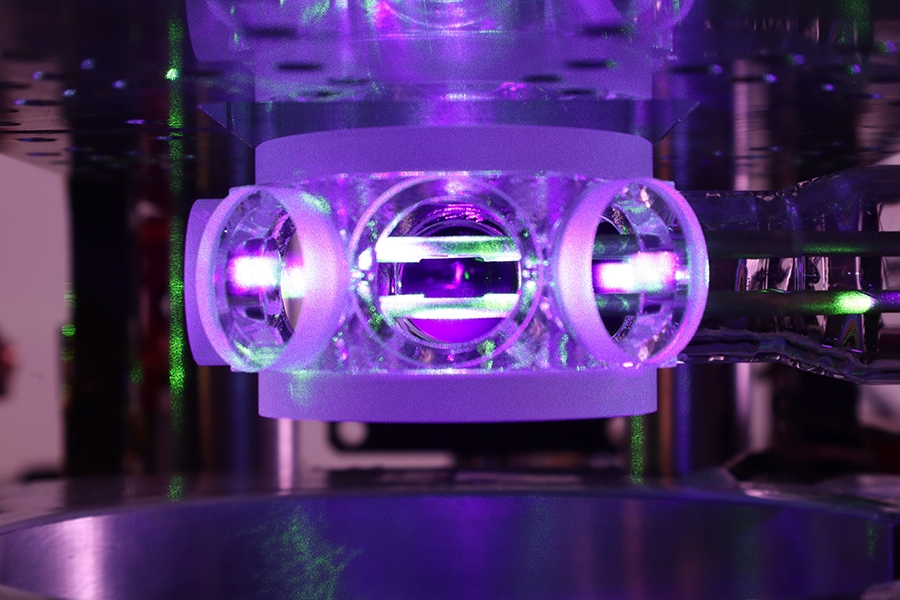
Unlike their bosonic counterpart, fermionic isotopes of alkaline-earth atoms benefit from having nuclear spin. This spin has been proposed for new many-body models, such as SU(N) physics, as well as the basis for new qubit architectures. In a new experiment, we seek to gain single-qubit-resolved control of arrays of Ytterbium-171 atoms, where quantum information is stored in the spin-1/2 nuclear spin of this isotope. We seek to engineer the resulting system to fully exploit the high two-qubit gate speeds possible with large Rydberg Rabi frequencies from the excited clock state. Beyond its use for metrology, we wish to leverage rapid control of the clock transition — a challenge in bosonic isotopes — to realize spatially-resolved control of Rydberg interactions as well as lossless single-qubit-resolved measurement. This suite of capabilities will be powerful for exploring QIP algorithms as well as many-body models for quantum simulation. Topics of particular interest to us are: 1) ultrafast two-qubit gates, 2) new many-body cooling methods, 3) implementation of promising NISQ-era algorithms, 4) multi-qubit gate protocols with local qubit measurement.
This work also dovetails with a collaboration with the Regal group, where we are developing a platform for using optical tweezer arrays in a cryogenic environment.
 The Physics Frontiers Centers (PFC) program supports university-based centers and institutes where the collective efforts of a larger group of individuals can enable transformational advances in the most promising research areas. The program is designed to foster major breakthroughs at the intellectual frontiers of physics by providing needed resources such as combinations of talents, skills, disciplines, and/or specialized infrastructure, not usually available to individual investigators or small groups, in an environment in which the collective efforts of the larger group can be shown to be seminal to promoting significant progress in the science and the education of students. PFCs also include creative, substantive activities aimed at enhancing education, broadening participation of traditionally underrepresented groups, and outreach to the scientific community and general public.