

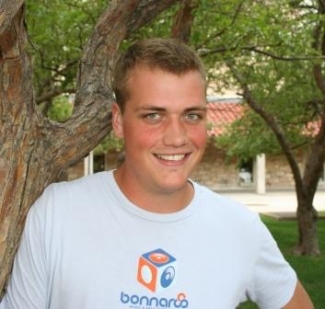
Ruzic
Occupation: Graduate Student
Nickname: Bruiser
Specialization: Ultracold collisions
BS: University of Illinois
With group: 2010-15
Current Whereabouts: Sandia National Labs
Quotes:
"Go Whitefish!"
"Is that how you deduced the reduced dipole that was induced?”
”Some dark place inside of me actually kind of enjoyed it.”
“If you can truly understand it, are you even doing it right?"
Ruzic Publications in the group
Statistical Aspects of Ultracold Resonant Scattering
M. Mayle, B. P. Ruzic, and J. L. Bohn, Phys. Rev. A 85, 062712 (2012).
Scattering of Ultracold Molecules in the Highly Resonant Regime
M. Mayle, G. Quéméner, B. P. Ruzic, and J. L. Bohn, Phys. Rev. A 87, 012709 (2013).
Quantum Defect Theory for High Partial Wave Cold Collisions
B. P. Ruzic, C. H. Greene, and J. L. Bohn, Phys. Rev. A 87, 032706 (2013).
Analyzing Feshbach Resonances — A Li-6 - Cs-133 Case Study
R. Pires, M. Repp, J. Ulmanis, E. D. Kuhnle, M. Weidemüller, T. G. Tiecke, C. H. Greene, B. P. Ruzic, J. L. Bohn, and E. Tiemann, Phys. Rev. A 90, 012710 (2014).
Multichannel Quantum Defect Theory for Ro-vibrational Transitions in Ultracold Molecule-Molecule Collisions
J. Hazra, B. P. Ruzic, N. Balakrishnan, and J. L. Bohn, Phys. Rev. A 90, 032711 (2014).
Quantum Defect Theory of Cold Chemistry with Product Quantum State Resolution
J. Hazra, B. P. Ruzic, J. L. Bohn, and N. Balakrishnan, Phys. Rev. A 90, 062703 (2014).
Radio-Frequency Spectrum of the Feshbach Molecular State to Deeply Bound Molecular States in Ultracold 40K Fermi Gases
L.-H. Huang, P.-J. Wang, B. P. Ruzic, Z.-K. Fu, Z.-M. Meng, P. Peng, J. L. Bohn, and J. Zhang, New J. Phys. 17, 033013 (2015).
Sandia National Labs
 The Physics Frontiers Centers (PFC) program supports university-based centers and institutes where the collective efforts of a larger group of individuals can enable transformational advances in the most promising research areas. The program is designed to foster major breakthroughs at the intellectual frontiers of physics by providing needed resources such as combinations of talents, skills, disciplines, and/or specialized infrastructure, not usually available to individual investigators or small groups, in an environment in which the collective efforts of the larger group can be shown to be seminal to promoting significant progress in the science and the education of students. PFCs also include creative, substantive activities aimed at enhancing education, broadening participation of traditionally underrepresented groups, and outreach to the scientific community and general public.