

Meyer
Nickname: Buttercup
Specialization: Molecules; horror movies.
BS: University of Washington
With group: 2004-2010
Current whereabouts: Los Alamos national Labs
Quote:
"I've never understood the logic of the chemists."
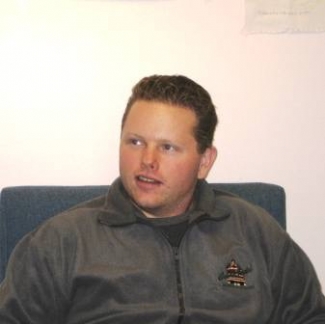
Here is Ed discussing spectroscopy with Ben Lev.
Meyer publications with the group
Candidate molecular ions for an electron electric dipole moment experiment -- Phys. Rev. A 73, 062108 (2006)
OH Hyperfine Ground State: From Precision Measurement to Molecular Qubits -- B. L. Lev, E. R. Meyer, E. R. Hudson, B. C. Sawyer, J. L. Bohn, and J. Ye, Phys. Rev. A 74, 061402(R) (2006).
Prospects for an Electron Electric Dipole Moment Search in Metastable ThO and ThF^+ -- E. R. Meyer and J. L. Bohn, Phys. Rev. A 78, 010502 (2008).
Influence of a Humidor on the Aerodynamics of Baseballs -- E. R. Meyer and J. L. Bohn, American Journal of Physics 76, 1015 (2008).
EDM Searches Based on Alkali or Alkaline-Earth Bearing Molecules -- E. R. Meyer and J. L. Bohn, Phys. Rev. A 80, 042508 (2009).
An Electron Electric Dipole Moment Search in the Triplet Delta Ground State of Tungsten Carbide Molecules -- J. Lee, E. R. Meyer, R. Paudel, J. L. Bohn, and A. E. Leanhardt, J. Mod. Optics 56, 2005 (2009).
Berry-like Phases in Structured Atoms and Molecules -- E. R. Meyer, A. Leanhardt, E. Cornell, and J. L. Bohn, Phys. Rev. A 80, 062110 (2009).
Product-State Control of Bi-Alkali Chemical Reactions -- E. R. Meyer and J. L. Bohn, Phys. Rev. A 82, 042707 (2010).
Chemical Pathways in Ultracold Reactions of SrF Molecules -- E. R. Meyer and J. L. Bohn, Phys. Rev. A 83, 032714 (2011).
High-resolution spectroscopy on trapped molecular ions in rotating electric fields: A new approach for measuring the electron electric dipole moment -- A. E. Leanhardt, J. L. Bohn, H. Loh, P. Maletinsky, E. R. Meyer, L. C. Sinclair, R. P. Stutz, and E. A. Cornell, J. Mol. Spect. 270, 1 (2011).
Precision Spectroscopy of Polarized Molecules in an Ion Trap
H. Loh, K. C. Cossel, M. C. Grau,. K.-K. Ni, E. R. Meyer, J. L. Bohn, J. Ye, and E. A. Cornell, Science 342, 1220 (2013).
Los Alamos National Labs
 The Physics Frontiers Centers (PFC) program supports university-based centers and institutes where the collective efforts of a larger group of individuals can enable transformational advances in the most promising research areas. The program is designed to foster major breakthroughs at the intellectual frontiers of physics by providing needed resources such as combinations of talents, skills, disciplines, and/or specialized infrastructure, not usually available to individual investigators or small groups, in an environment in which the collective efforts of the larger group can be shown to be seminal to promoting significant progress in the science and the education of students. PFCs also include creative, substantive activities aimed at enhancing education, broadening participation of traditionally underrepresented groups, and outreach to the scientific community and general public.