

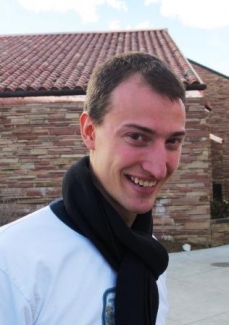
Corson
Occupation: Graduate Student
Nickname: Superman
Specialization: Many-Body theory
MS: Brigham Young University, 2011.
With group: 2011-16
Current wherabouts: Lincoln Labs
Quote: “Here’s what happens when you punch the condensate in the gut."
Corson Publications with the group
Stability Spectroscopy of Rotons in a Dipolar Bose Gas
J. P. Corson, R. M. Wilson, and J. L. Bohn, Phys. Rev. A. 87, 051605R (2013).
Geometric Stability Spectra of Dipolar Bose Gases in Tunable Optical Lattices
J. P. Corson, R. M. Wilson, and J. J. Bohn, Phys. Rev. A 88, 013614 (2013).
Quenching to Unitarity: Quantum Dynamics in a 3D Bose Gas — A. G. Sykes, J. P. Corson, J. P. D’Incao, A. P. Koller, C. H. Greene, A. M. Rey, K. R. A. Hazzard, and J. L. Bohn, Phys. Rev. A 89, 021601(R) (2014).
Bound-State Sigantures in Quenched Bose-Einstein Condensates — J. P. Corson and J. L. Bohn, Phys. Rev. A 91, 013616 (2015).
Ballistic Quench-Induced Correlation Waves in Ultracold Gases — J. P. Corson and J. L. Bohn, Phys. Rev. A 94, 023604 (2016).
Stable Production of a Strongly-Interacting Bose-Einstein Condensate via Mode_matching
E. J. Halperin, M. W. C. Sze, J. P. Corson, and J. L. Bohn, Phys. Rev. A 100, 013608 (2019).
Lincoln Labs
 The Physics Frontiers Centers (PFC) program supports university-based centers and institutes where the collective efforts of a larger group of individuals can enable transformational advances in the most promising research areas. The program is designed to foster major breakthroughs at the intellectual frontiers of physics by providing needed resources such as combinations of talents, skills, disciplines, and/or specialized infrastructure, not usually available to individual investigators or small groups, in an environment in which the collective efforts of the larger group can be shown to be seminal to promoting significant progress in the science and the education of students. PFCs also include creative, substantive activities aimed at enhancing education, broadening participation of traditionally underrepresented groups, and outreach to the scientific community and general public.